A career builtaround what’s next.
Making television. Building brands. Launching networks. Leading creative teams. And, increasingly, designing the technology behind how creative work gets made.
Architecture / Environmental Design
Earned a degree in Environmental Design from Texas A&M University’s College of Architecture, with a multidisciplinary education spanning architectural design, spatial planning, visual communication and systems-based problem solving.
The studio-intensive program emphasized developing complex ideas from concept through execution and communicating them with clarity and precision — establishing a design foundation that would later extend into television, branding, media, technology and product development.
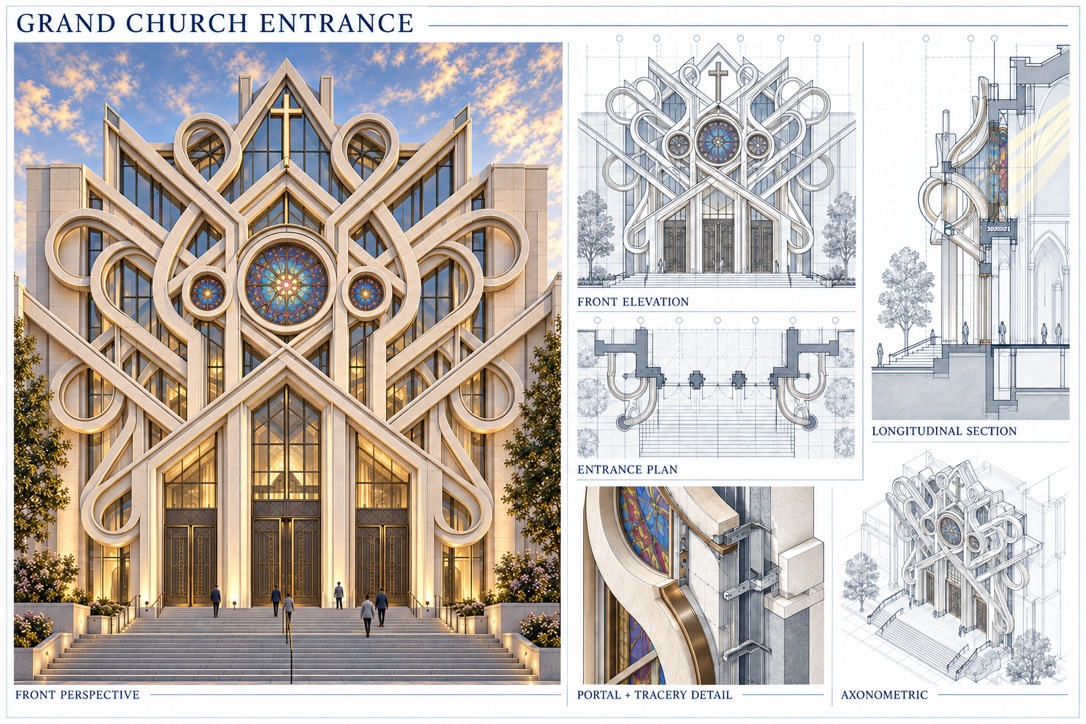
A sanctuary entrance where the stonework refuses to sit still — ribbons of carved limestone loop and weave around a central rose window before landing as the portal itself. One board carries the whole argument: perspective, elevation, plan, section, and the tracery detail that proves it could actually be built.
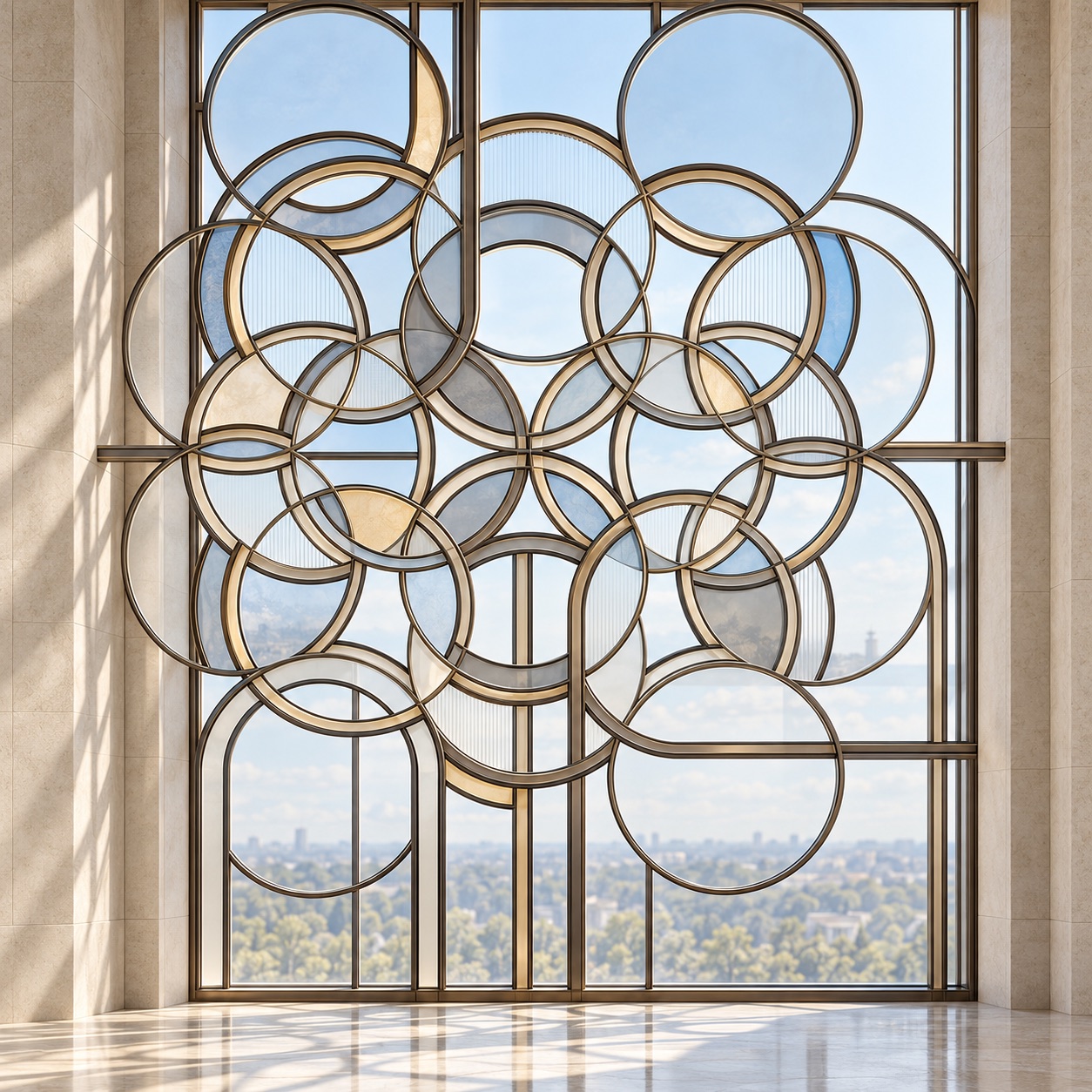
A study in geometry and light: overlapping bronze-framed circles glazed in clear, fluted and amber glass, composed so the window draws itself across the floor every afternoon. The assignment was a wall; the answer was a lens.
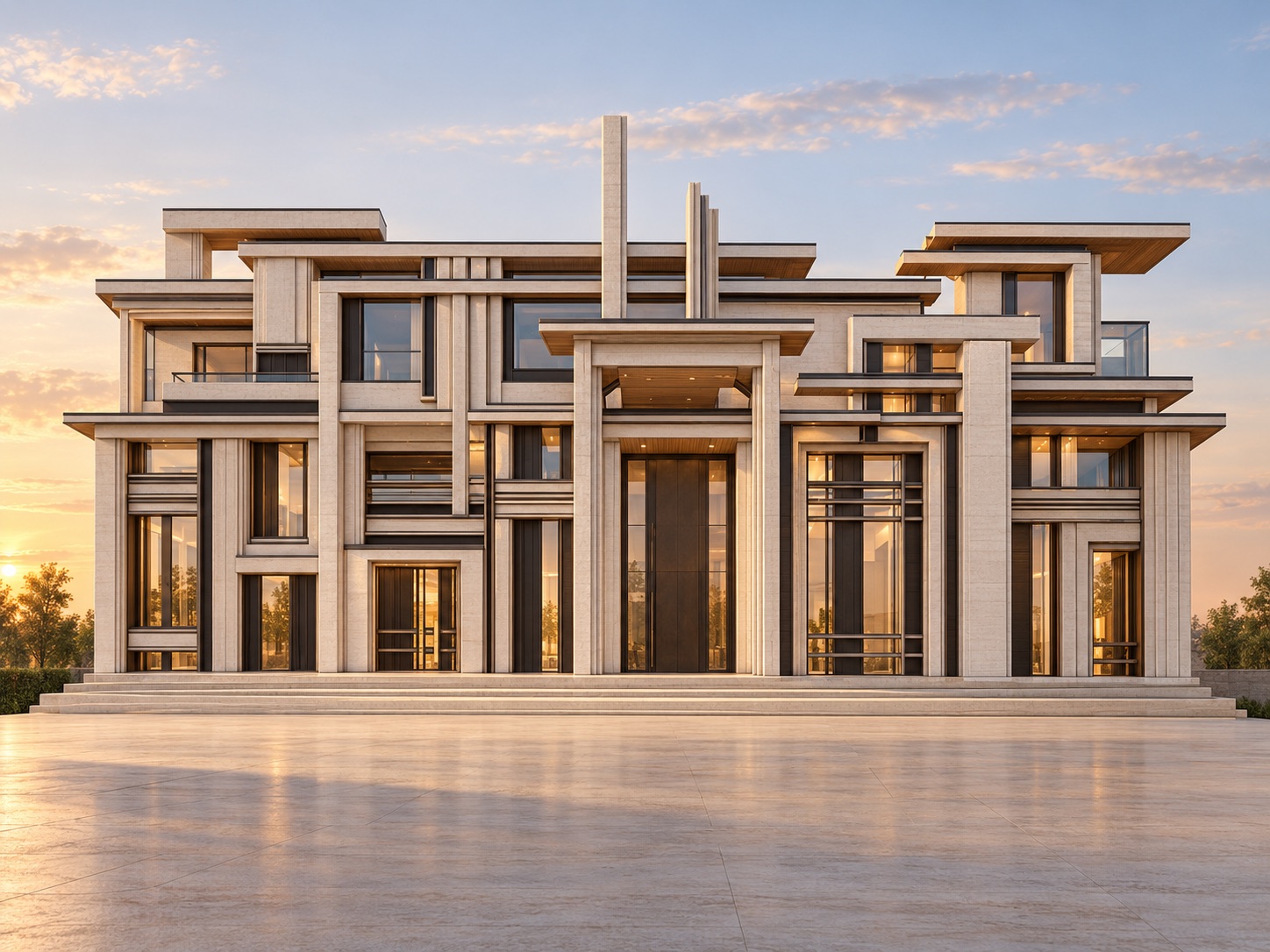
A private residence built from a strict rectilinear grammar — pale stone piers, dark mullions, floating roof planes — equal parts Prairie School discipline and De Stijl composition. The facade is the floor plan, stood upright.
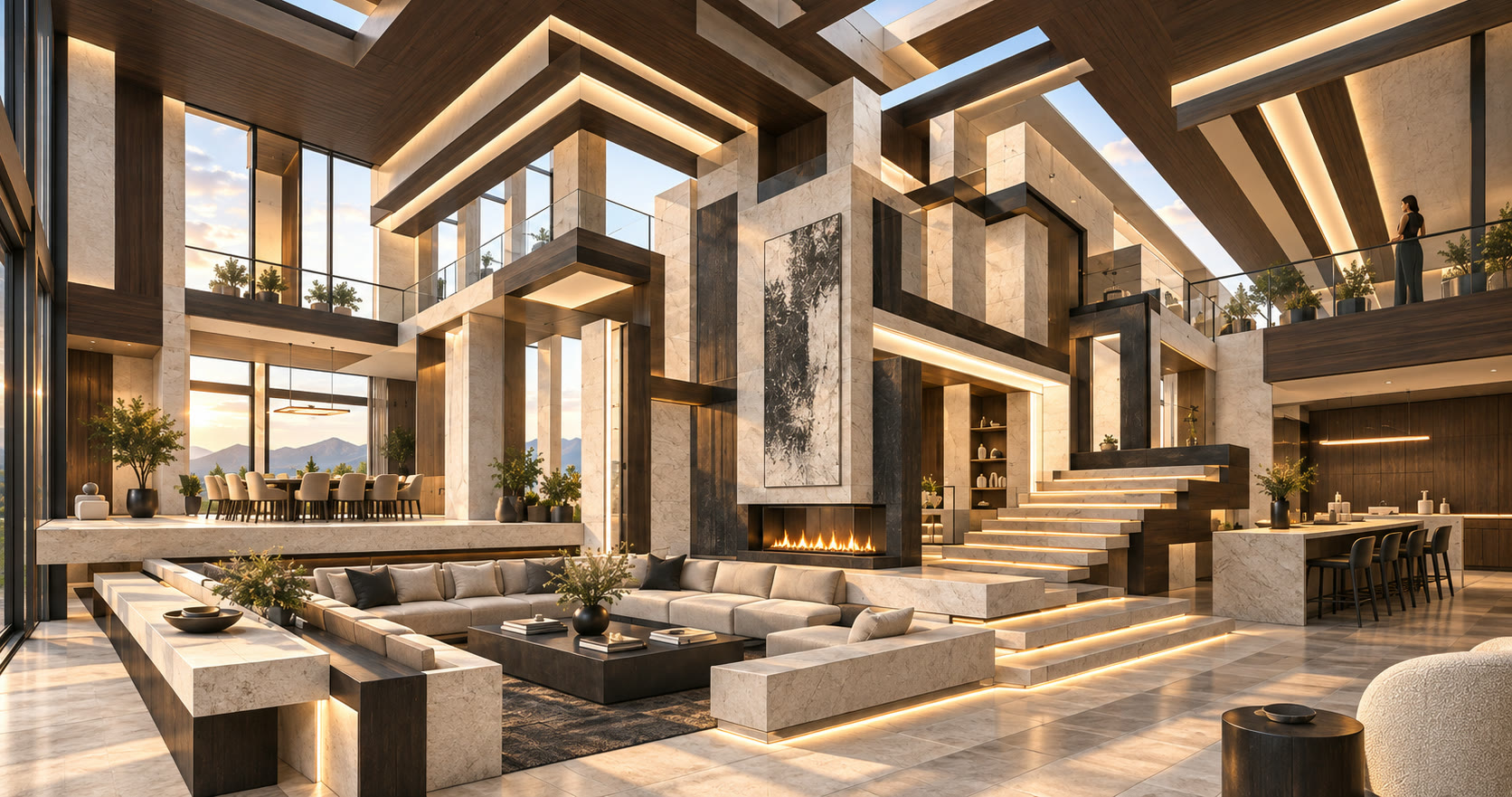
Inside, the same grammar turns volumetric: interlocking wood-coffered ceilings, marble piers and a floating stone stair frame a sunken lounge around the fireplace. Concealed light traces every beam and tread, so at dusk the structure itself becomes the chandelier.
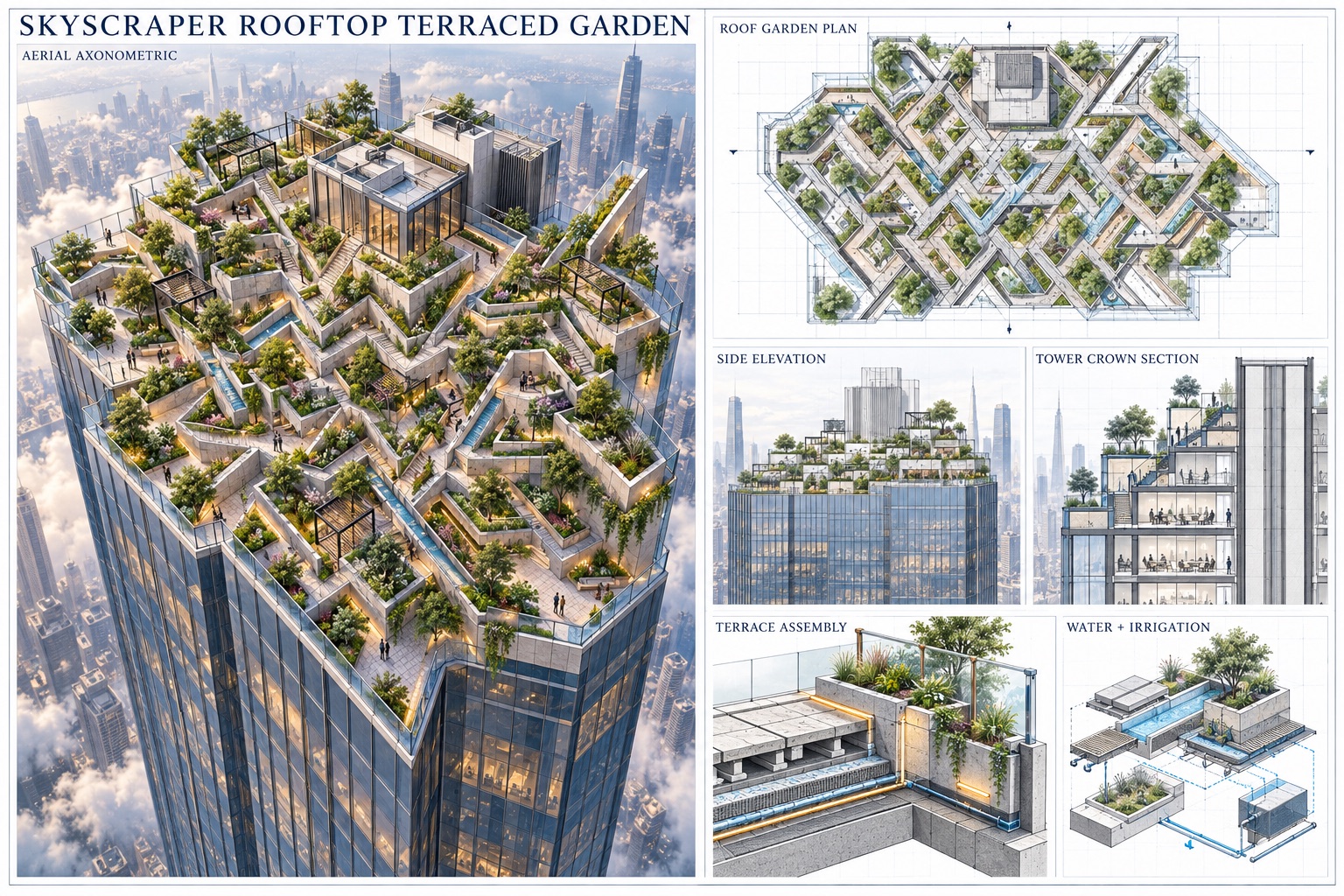
What if the top of a tower belonged to people instead of machinery? The crown becomes a public garden — interlocking terraces stepping down through trees, water and walkways — worked out from aerial view down to the terrace assembly and the irrigation that keeps it alive at altitude.
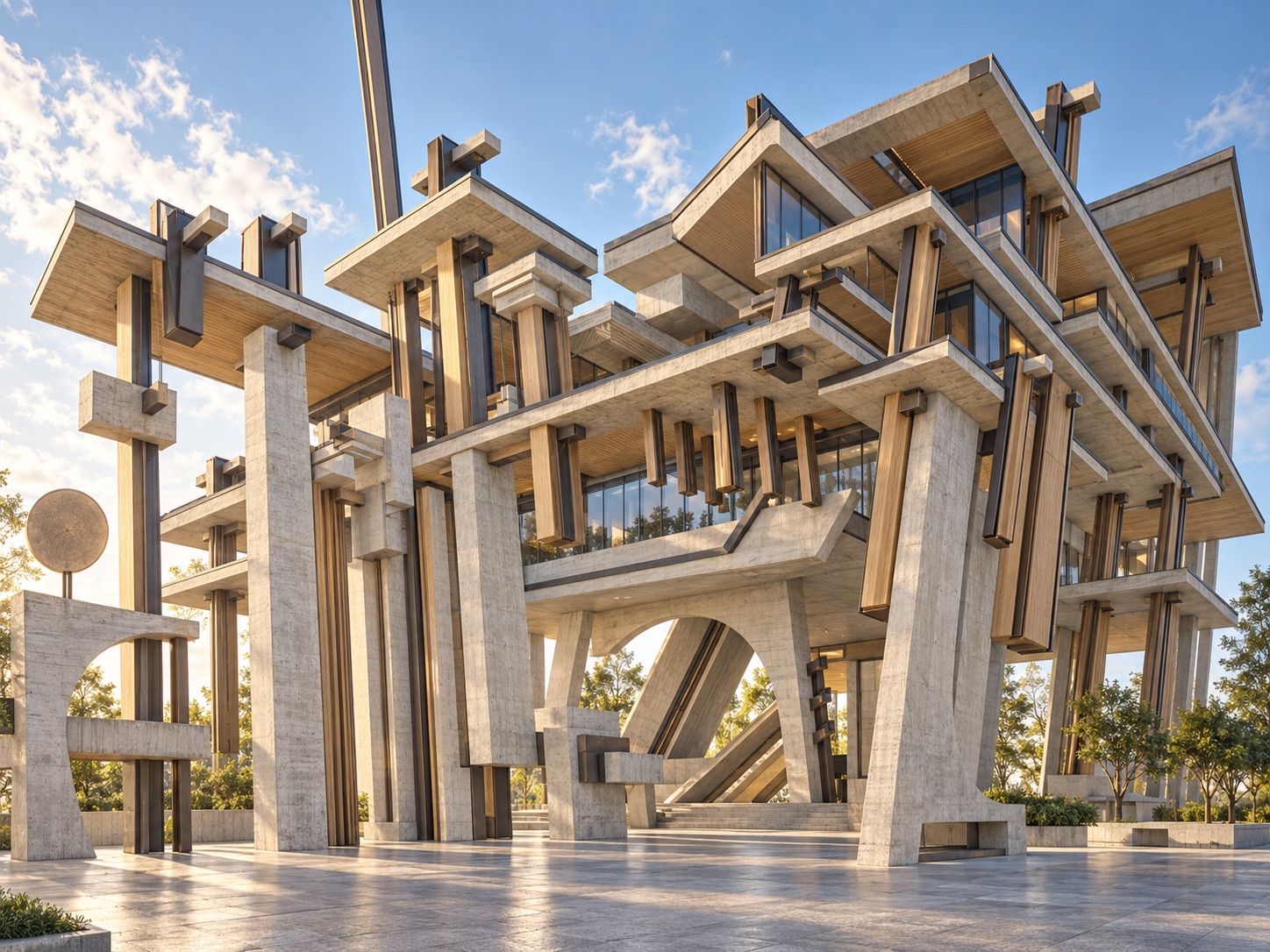
A pavilion that hides nothing: board-formed concrete piers, steel channels and timber infill stacked into a constructivist assembly where the structure is the architecture. Every joint is on display; nothing is cladding.
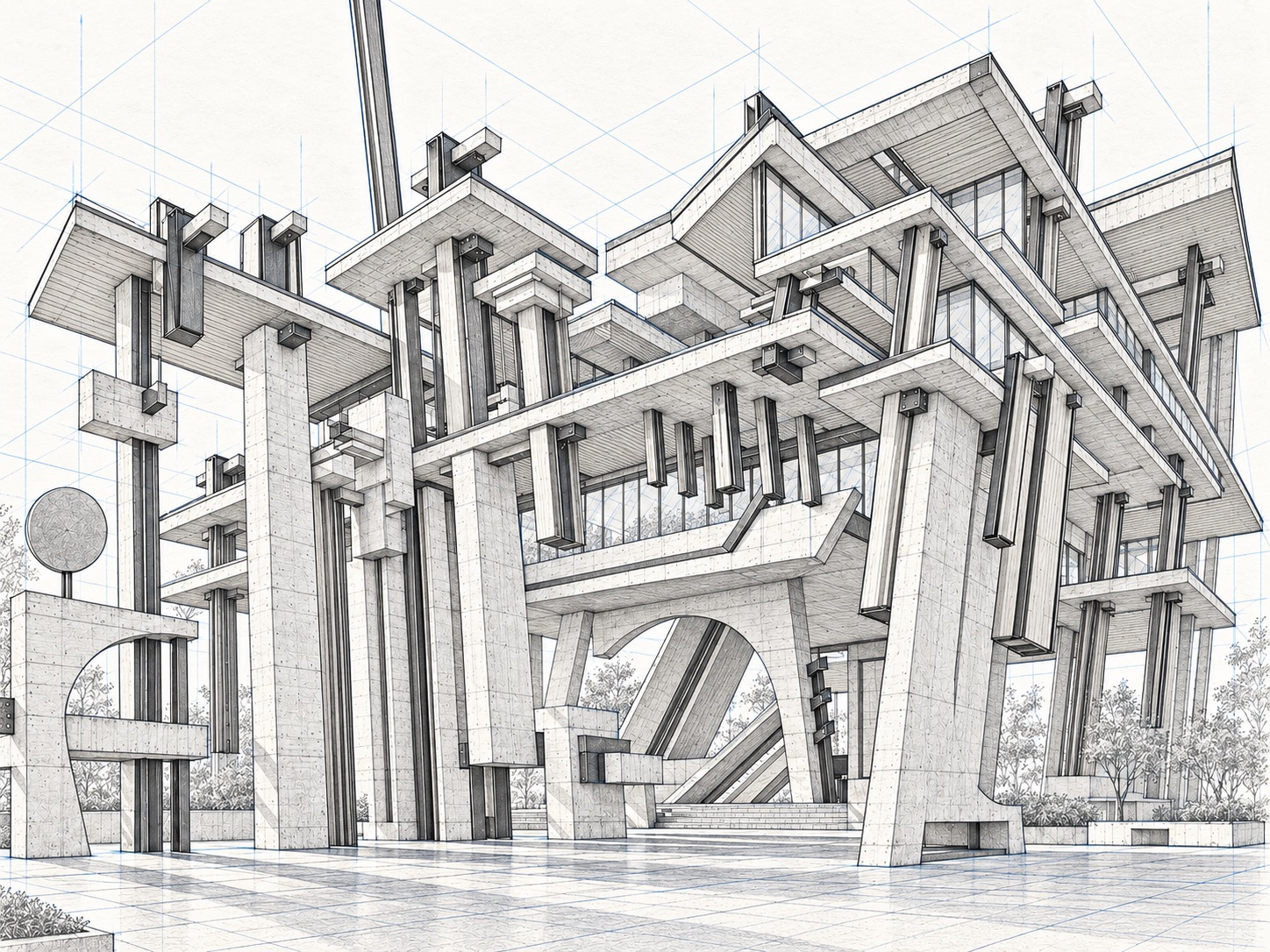
Where the pavilion started: a hand-drawn perspective, construction lines still showing. Studio taught us to resolve a building on paper before trusting it to anything else — the drawing is the thinking.
Fine Art / Editorial
Studio wasn’t the only outlet. While studying at Texas A&M, I became a cartoonist for The Battalion, the university’s student newspaper. My cartoons ran regularly, and the work earned awards while I was still a student.
Looking back, this was the real beginning of a career in media. A cartoon forces you to communicate an idea immediately. Limited space. The audience has to get the premise fast. Design, timing, composition and humor all working together.
I didn’t know it then, but those same principles would become central to almost everything I’d do in television and advertising.
The drawings started moving.
Degree in hand, I moved to Atlanta. My first professional job was at 70/30 Productions, working on Cartoon Network’s Sealab 2021 with Matt Thompson and Adam Reed — who would go on to create Archer.
Going straight from drawing cartoons for a college paper into an animated television series felt strangely natural. It was my introduction to professional television — an industry that combined everything I loved about architecture: design, storytelling, problem solving, and building things. Just in an entirely different medium.
Learning television.
From animation I moved into broadcast, joining WGCL, CBS 46 in Atlanta as a promotion coordinator — and worked my way into producing, creating promos and trailers for the station’s 11 PM and morning newscasts.
This was where I really learned the craft. Writing. Editing. Producing. Shooting. Music. Sound design. Branding.
And, most importantly: figuring out how to make someone feel something in thirty seconds.
Finding my voice.
The first major showcase. Producer to senior producer — image and branding campaigns, ambitious live-action productions, film shoots, and multiple Promax awards.
San Francisco was where television promotion became much more than a job. I became fascinated by the combination of filmmaking, editing, design, music, marketing and audience psychology that can make someone feel something about a television brand.
Building networks.
Los Angeles opened an entirely different chapter. I joined a small NBCUniversal team exploring how unused cable bandwidth, existing content libraries and new distribution technologies could become entirely new television businesses.
For the first time, I wasn’t promoting television networks. I was helping build them. I helped create NBC2Go and NBC News2Go — television services designed for mobile phones, years before watching TV on a phone was ordinary.
Because the group was small, the role crossed every discipline: graphics, branding, content, scheduling, programming, technical implementation, operations. I also helped build and run emerging networks including Chiller and Sleuth. We didn’t launch networks and walk away — we operated them.
It gave me an unusually broad understanding of television: not only how to create content, but how an entire network actually works.
LOST and the internet.
At ABC I worked across primetime as a network promotion producer — campaigns for LOST, Desperate Housewives, Grey’s Anatomy, FlashForward, The River, plus launches, specials and Upfront presentations.
But LOST became the important one. Instead of treating the internet as another place to put TV promos, we experimented with entertainment made specifically for online audiences. I created LOST Untangled — a comedic companion series produced with The Jim Henson Company that untangled the show’s mythology for the web. Millions of views. Microsoft signed on as sponsor.
It proved an idea that would shape the rest of my career: when a new distribution platform appears, don’t move the old content onto it. Ask what new kind of content the platform makes possible.
Leading creative.
Leaving ABC to become Vice President of On-Air & Design was the major transition: no longer responsible only for the work I personally created, but for building the team and the creative system capable of producing great work at scale.
I rebuilt the network’s on-air creative team and oversaw promotion, branding and design through a period of extraordinary audience growth and some of the strongest ratings in the network’s history.
And we were constantly launching — The American Bible Challenge with Jeff Foxworthy, Skin Wars with Rebecca Romijn, and a continuous pipeline of originals, initiatives and brand campaigns.
What if I built my own network?
After Game Show Network, I stepped away from traditional network television and started building something of my own: a television network devoted entirely to space.
Space Channel started, quite literally, in my garage. The idea was a global media brand covering science, exploration, entertainment and the rapidly emerging commercial space industry.
I developed the programming, identity, technology and business behind the network — while continuing to work professionally in television.
Back to NBC.
Six years inside one of the premier television promotion operations in the industry — where every frame, sound, line, musical choice and emotional beat had to compete at the highest level of network television.
At the same time, in the background, Space Channel kept growing.
Going all-in on space.
In 2021, after securing funding, I left NBC and committed to Space Channel full-time — and moved to Brownsville, Texas, putting the company at the doorstep of the most consequential development in modern spaceflight: SpaceX’s Starship program.
What began in a garage was becoming a functioning streaming television platform. And once again I was crossing disciplines: programming, production, branding, streaming, technology, distribution, advertising, business development.
Space Channel brought together almost everything I had learned in the previous two decades. This isn’t another employer on the timeline. It’s something I built.
From making content
to building technology.
AirLab began in 2022 as an in-house production capability for Space Channel. It quickly became something much larger — producing for outside clients, including major political campaigns and organizations needing sophisticated, fast-turnaround advertising and storytelling. Trailers, commercials, corporate films, branded content, and emerging AI-assisted production.
Then another problem caught my attention. Operating streaming television, I kept watching valuable advertising inventory go unused. So I designed a system to transform unused streaming ad time into monetizable inventory instead of dead air — technology that led to a multi-year relationship with ORKA, where AirLab worked to develop the concept for its streaming platform.
AirLab was evolving from a production company into something different: a creative technology company.
Building the tools.
Today I operate Space Channel and AirLab while taking on select creative clients. I still produce. I still edit. I still make trailers, commercials, campaigns and films.
But after decades of using creative technology, I’m now building it: AI-assisted applications, effects, production systems and tools designed around problems I’ve encountered firsthand as an editor, producer, creative executive and network operator.
The objective isn’t replacing creativity. It’s removing the friction around it. Better tools for creative people. Automating the tedious parts. Letting an individual creator or a small team do what once required enormous infrastructure.
Which brings everything strangely full circle. I started as an architecture student learning to design structures. Then I drew cartoons. The drawings started moving. I learned to make television, build brands, then teams, then networks, then companies. Now I’m building the systems that help other people create.
The medium keeps changing.
The thing I love doing hasn’t.